Introduction
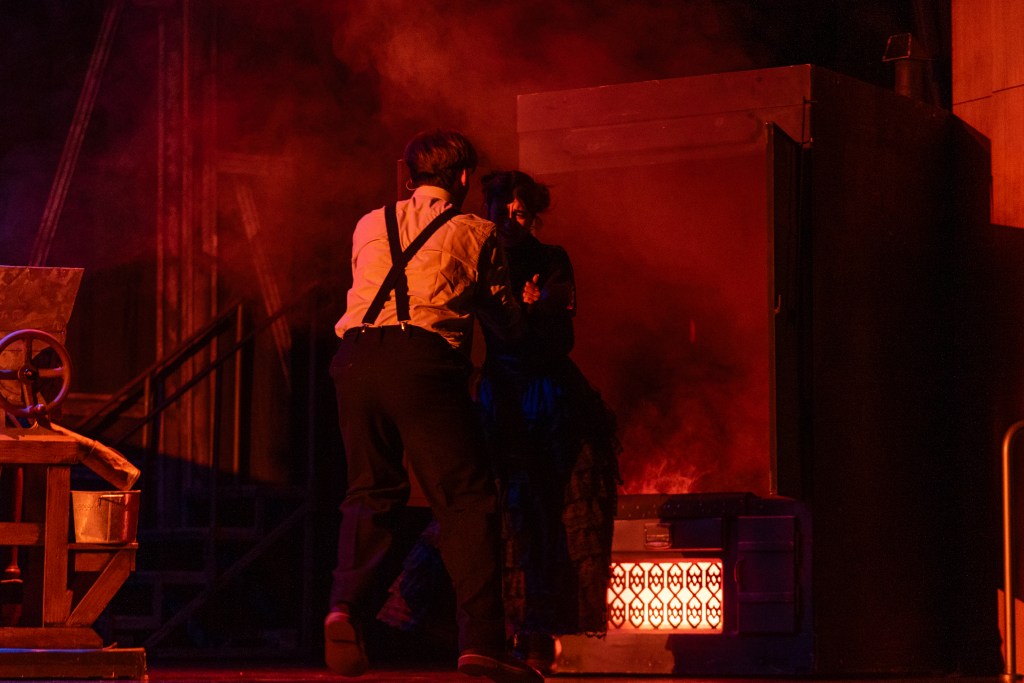
When we think of the great deaths that have happened to different characters in musical theater, Billy Bigelow from Carousel, Tony from West Side Story, Phillip from Hamilton and the entire cast of Les Miserables come to mind. However for my money, the best and greatest of all these deaths occurs in Sweeney Todd for the character of Nellie Lovett. This humble analysis attempts to breaks down what makes Lovett’s demise the greatest death scene in the musical theater canon in addition to my exploration into bringing this scene to life when I directed Sweeney Todd at Saint Augustine High School this past spring.
Setting The Stage
For those unacquainted with Stephen Sondheim’s masterwork, Sweeney Todd tells the grisly story of a mad London barber who becomes hellbent on revenge against the Judge who ruined his life and the life of his family; Lucy, his wife (who is presumed dead) and Johanna, his daughter. He teams up with Lovett to have his victim’s bodies disposed of by cooking them into tasty meat pies.
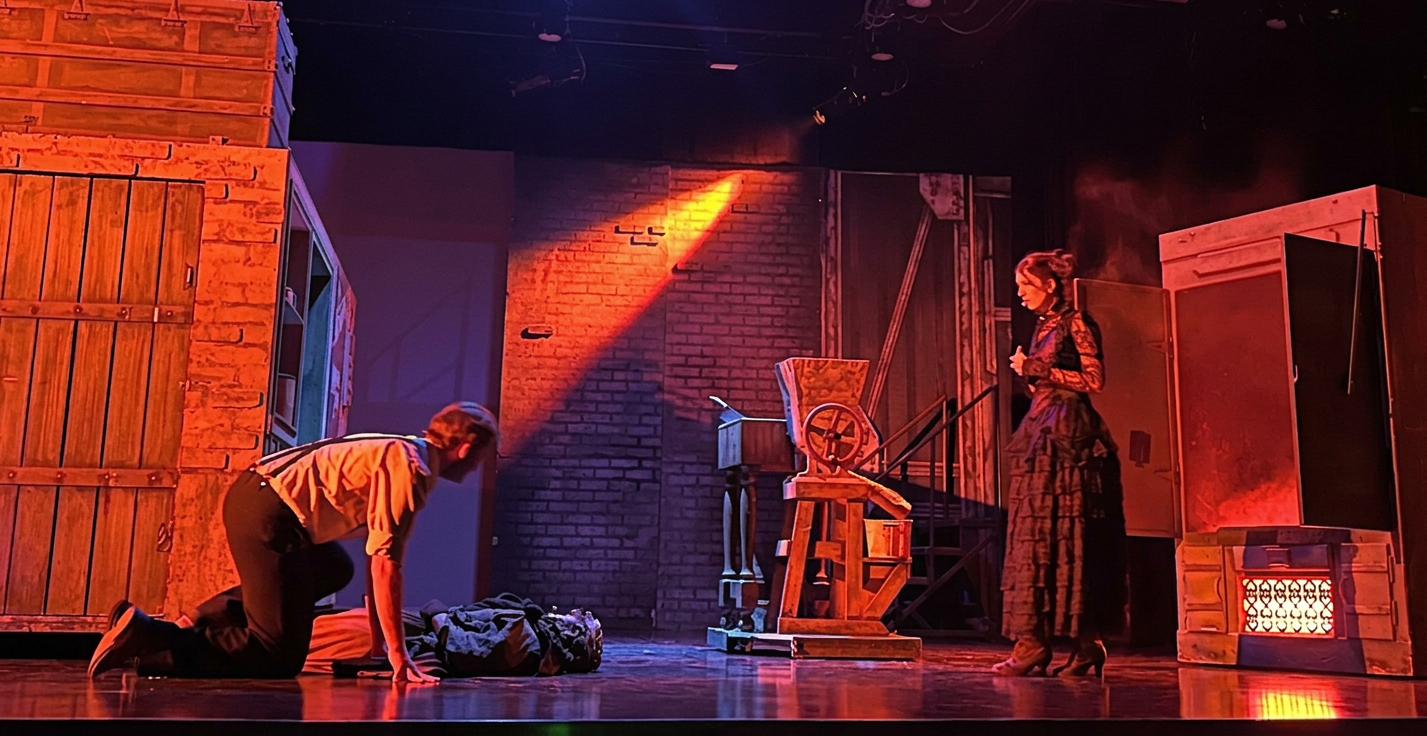
In the final sequence in Act II, Todd discovers in Lovett’s bakehouse that a Beggar Woman who wandered into his barber shop, and later dispatched by Todd himself, was actually his wife Lucy. Todd is horrified and blames Lovett for not telling him. “From the first moment I walked into your shop’ Todd exclaims, ‘You knew my Lucy lived!”. Lovett in return tries to justify her reason for not telling Todd that Lucy was alive and professes her love for him. Todd collects himself, calms her nerves and assures all is forgiven. Lovett begins to reinstate her fantasy of a life by the sea with him all the while unknowingly being inched closer and closer to the bake oven by Todd. Todd finally tricks her, flings her into the oven and closes the oven doors behind her as black smoke belches from the oven.
Analysis
The idea of Lovett being thrown into the oven by Todd comes from the adaptation by Christopher Bond upon which the musical is based. In earlier adaptations of Sweeney Todd, such as those from the Penny Dreadfuls, Lovett is defeated by being tried and hanged for her crimes.
From a story perspective, what makes this death scene so wonderfully macabre is the irony that the pie maker, Lovett, dies with her pies in her own pie oven. Lovett’s death is also an allusion to the cannibalistic witch in Hansel and Gretel who is tossed into the oven at the hands of Gretel (I would later acknowledge this allusion by giving my actress playing Lovett a pair of stereotypical black and white stripped witch socks to wear under her dress).
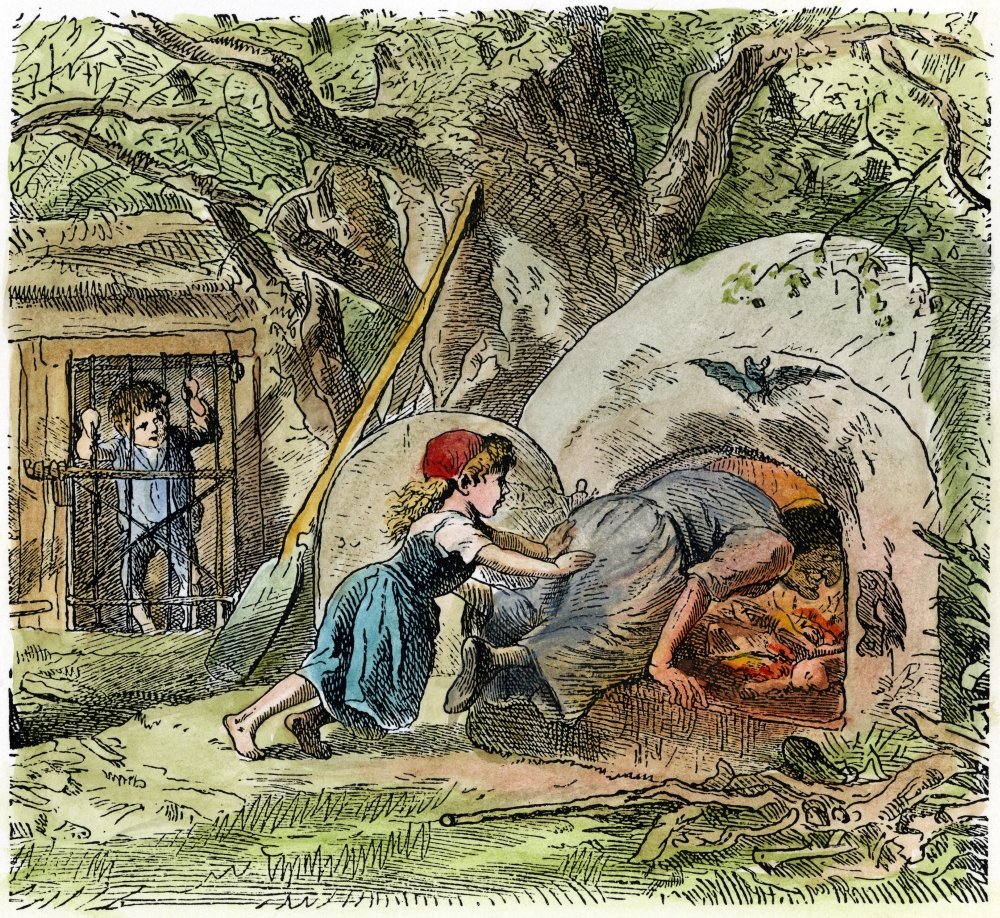
As director and actor Will Blum observed, Todd could have easily killed her slitting her throat (and some productions have gone that route when the budget for an oven is not available) but decided to give Lovett a far more painful and agonizing death than the quick slitting of the throat.
The music Sondheim has chosen for this moment is a reprise of the Act One Finale, “A Little Priest”. In “A Little Priest” Todd and Lovett conspire to turn the barber shop victims into different flavors of meat pies. This moment, as Will Blum stated, is when Todd and Lovett are at their happiest together and the moment when Lovett believes she and Todd fell in love. Todd, who has never romantically loved her, knows of Lovett’s affection for him and reprises this song as a way to coax her into a place of security. Sondheim manages to squeeze in a tiny reprise of Lovett’s Act II number “By The Sea”, a number in which Lovett confesses her dream of a married life with Todd in a seaside town. Inserting “By The Sea” into this moment helps justify this number’s existence in the show (“By The Sea” could have been easily cut from the score and the story would still continue on with nothing lost) and makes Lovett’s demise even more tragic as the man Lovett dreams to have a life with decides not to take her to the sea but instead decides to burn her alive. Sondheim also leaves a lyrical clue as to the lie Todd is giving Lovett when he sings, “The history of the world, my pet…Is learn forgiveness and try to forget”. We as the audience know Todd is lying due to the fact in Act One the chorus sang, “He’d seen how civilized men behave/He never forgot and he never forgave”.
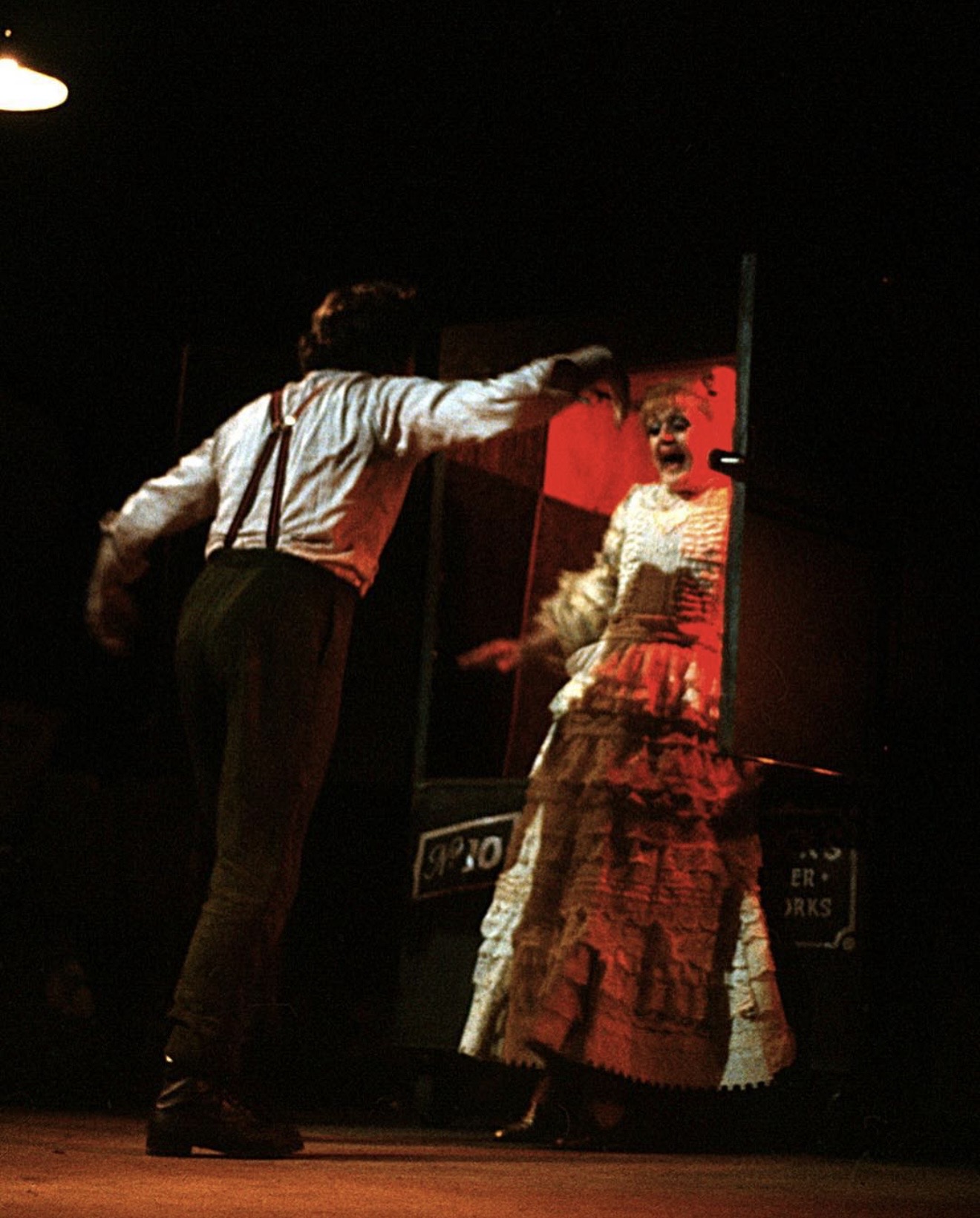
In Hal Prince’s original direction, a factory whistle blasts each time a death of a major character happens (Adolfo Pirelli, Jonas Fogg, Judge Turpin and later for Todd’s death at the hand of Tobias Ragg). There are two major characters who do not have a factory whistle attached to their death but instead are filled with specific music; the Beggar Woman/Lucy and Lovett. When the Beggar Woman dies, Sondheim uses a leitmotif used throughout the show for her death (This leitmotif is associated with the lyric, “And my Lucy lies in ashes”). When Lovett dies, Sondheim makes the music bombastic, the licensed script saying, “The music booms like an earthquake”. Thematically this makes sense as these women are the two essential figures in Todd’s life making their deaths different from the rest.
In observing different actresses and their take on the role of Lovett, I have observed that there have been overall three different ways this scene has been played. The first choice is that Lovett believes every word Todd says, fully divulging into her belief that Todd believes what she did was right and finally admitting his love for her (Helena Bonham Carter and Dorothy Loudon). The second choice is that Lovett is frightened by Todd, tries to make up for what she did and attempts to calm him down (Emma Thompson, Annaleigh Ashford and Patti LuPone). The third way is that Lovett knows what will become of her due to the lie she told so she uses this opportunity to hold Todd and dance with him one last time (Angela Lansbury, if you don’t believe me, look at her eyes and mannerisms as she dances with him).
In addition to acting choices, there are also directorial choices to be made in this scene, primarily whether or not Lovett is simply pushed into the oven like in the 2023 revival or she is waltzed into the oven like in the 2007 feature film. When Hal Prince originally directed the show on Broadway, Lovett was pushed in. However, when Prince’s touring production was recorded for television Angela Lansbury was waltzed into the oven by George Hearn. Later when Prince revived his production for New York City Opera, Elaine Paige was waltzed into the oven as well.
Another choice that is made is in regards to Lovett screaming. While Bond and Wheeler’s published scripts say that Lovett screams as she is being burned alive, some productions such as the 1980 original London production and the 2012 London revival do not have her scream. This could be for reasons such as; Sondheim’s music and Jonathan Tunick’s orchestrations take care of this musically, the practical reason of helping the actress playing Lovett not lose her voice nightly by screaming or to imply that the oven is so sound proof due to its grandiose size and it’s iron material that the audience can’t hear her scream.
A Personal History
In the early months of 2007, a trailer for a new musical movie, Sweeney Todd, directed by Tim Burton was released on Youtube. I knew of Sweeney Todd as Angela Lansbury’s performance of “The Worst Pies in London” was included in a DVD I was gifted for Christmas called Broadway’s Lost Treasures. Hearing about the upcoming film piqued my interest to learn more about the musical and decided to watch the 1982 filmed touring production. When I watched the “Final Sequence” I was in absolute shock to discover that not only the Beggar Woman was Lucy but that Lovett was tricked into being tossed in an oven. I became completely enthralled by the turn of events of this scene and was completely blown away by the visual effects used on Helena Bonham Carter when I finally went to see the film version. After school, I would pretend to be Mrs. Lovett by re-enacting the scene with the CD of the original Broadway cast using the closet door as the oven and a flashlight to be used as the light coming from the flames. Each time I would see the show live or watch productions on Youtube, I would judge each version of the show by the way Lovett’s death was handled. Most of the time when I saw the show live, I felt cheated or did not get the impact of Lovett’s death due to budget restrictions with Lovett being thrown into an imaginary oven represented by a door or red curtains or the moment was not given proper care, coming across lackluster (it lacked….luster).
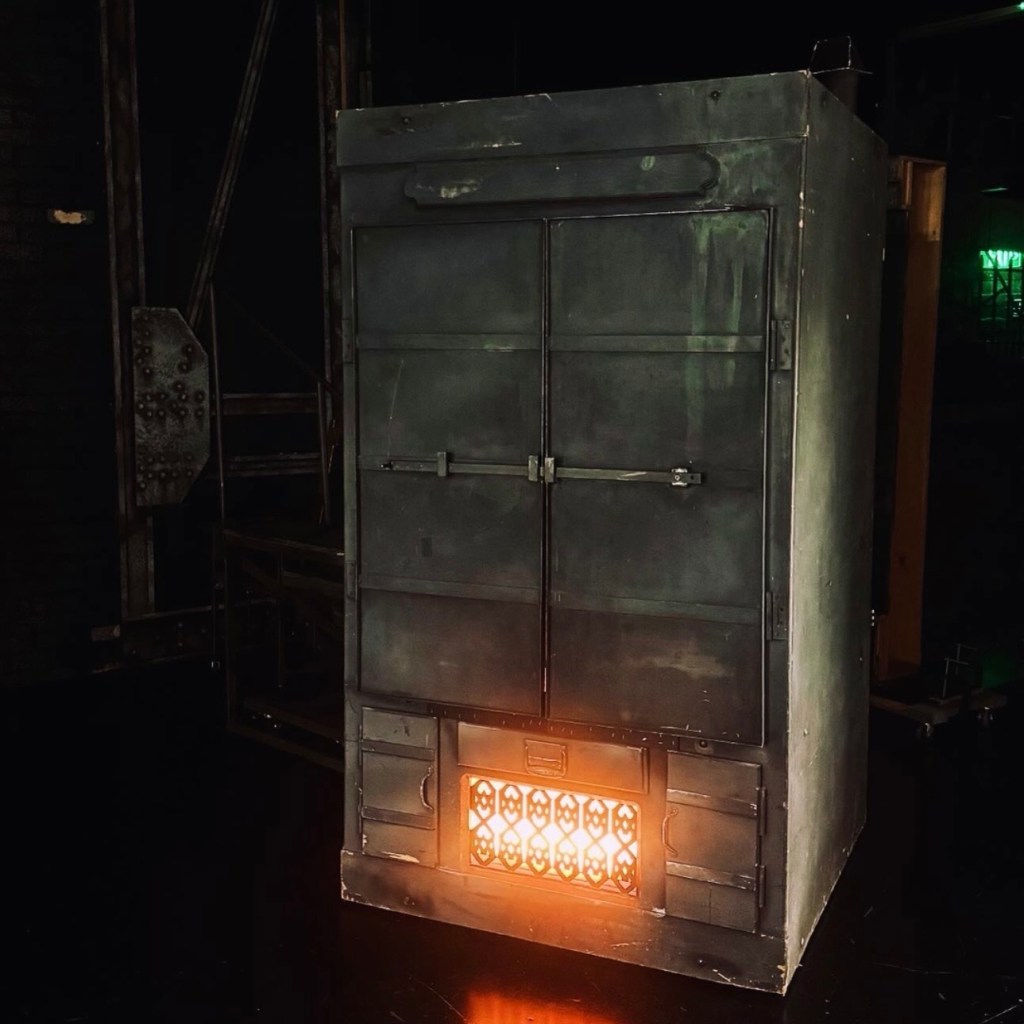
When the glorious opportunity to direct Sweeney Todd presented itself, in addition to acquiring a professional rental set that replicated the original production, I knew this was at last an opportunity to right the wrongs of previous productions and perfect my favorite moment in the show.
Pre-Planning
In pre-preparation for Lovett’s demise, I began with a series of questions. The first being which way to play the scene. For me, I decided that Lovett would be delusional in her love for Todd, not knowing what’s coming next for her. This choice was made to have the moment a surprise not only for Lovett but for the audience who had never seen this show before as Todd throws her in. The moment would be played gently as the two reprise “A Little Priest” only to have this tender moment quickly and violently changed.
In planning on the music for this segment with music tracks, I edited two musical moments. The first was to gradually accelerate the tempo and make the music gradually get louder as Todd got closer to the oven (in music terms: poco a poco accelerando and poco a poco cresendo) to help build the excitement. The other was to extend the bombastic final chord for at least fifteen seconds. Furthermore, I decided that the actress playing Lovett would not sing her final lines of “Just keep living it, really living it” but would go the same route as Dorothy Loudon (my favorite Mrs Lovett, Sondheim apparently was not a fan of hers) by fearfully yelling at Todd, “Let go of me! Let go!”.
The next question was whether or not to push or waltz Lovett on her way to the oven. While I personally prefer the waltz as exemplified in the 1982 televised version and the 2007 film, I have watched productions do the waltz and it has never come across right to me compared to the two previously mentioned versions. This can be because the waltz feels contrived or it overtly gives away what Todd will plan to do as he waltzes her closer to the oven. Therefore, I decided instead, Todd would grab her and walk her backwards towards her fiery demise. I also made sure that Todd would escort Lovett far away from the oven in order to give Todd enough walking distance to push her in.
The final question was whether or not to have Lovett to scream inside the oven to which I quickly decided she wouldn’t for two valid reasons. I have seen many live productions in which Lovett screams but the scream never comes across convincingly as blood-curdling (compared to Helena Bonham Carter’s scream, a close second would be Imedla Staunton) or the actress playing Lovett just randomly stops. I was also concerned with the vocal health of whoever my actress playing Lovett would be with how loudly screaming in a box filled with fog fumes would affect the actress’ voice (I recently did a show where the theater continuously blasted the fog machine all over the stage which caused a lot of vocal damage not only to me but many of my castmates). I would justify not having Lovett scream by having the actress stop screaming as soon as the doors where closed upon her to communicate to the audience that the oven was so heavy and robust we couldn’t even hear her scream. I also considered the moment to be even more horrifying that the audience can’t even hear her scream.
In pre-production, I also took into consideration Todd’s role in this sequence by building upon what Hal Prince only hinted at in his original staging. After Todd slams the oven doors on her, Prince proceeds to have Todd hold onto the oven doors as she ferociously bangs on the doors to get out. Once the banging on the doors subsides, Todd recoils due to the heat radiating from the metal doors and then proceeds to go back to the lifeless body of the Beggar Woman on the floor of the bakehouse.
The first way I built up this moment was to emphasise the heat of the oven doors. This type of industrial oven is not the kind we have today in which extra layers are added to the outside of the oven to protect from the heat. This type of oven was heavy cast iron metal and the doors would have been just as hot on the outside as they were on the inside. Speaking from experience, when I was growing up in a cold mountain town, my childhood home had a cast iron fireplace with a glass window in the center. As a very young toddler, a traumatizing event happened to me when I naively put my hands on the glass window of the fireplace and severely burned my hands.
To communicate the heat of this bake oven, I made sure our Lovett always opened the oven with a rag over her hands in scenes prior to her death and had the character of Tobias curiously touch the oven doors only to quickly recoil due to the heat in the scene when he comes to tour the bakehouse. Therefore, when Todd tries to keep Lovett inside the oven, his hands would be burning and hurting, making it more of a struggle to lock her inside. When we finally gave up, he would fall to the ground, grabbing his arms in pain and panting.
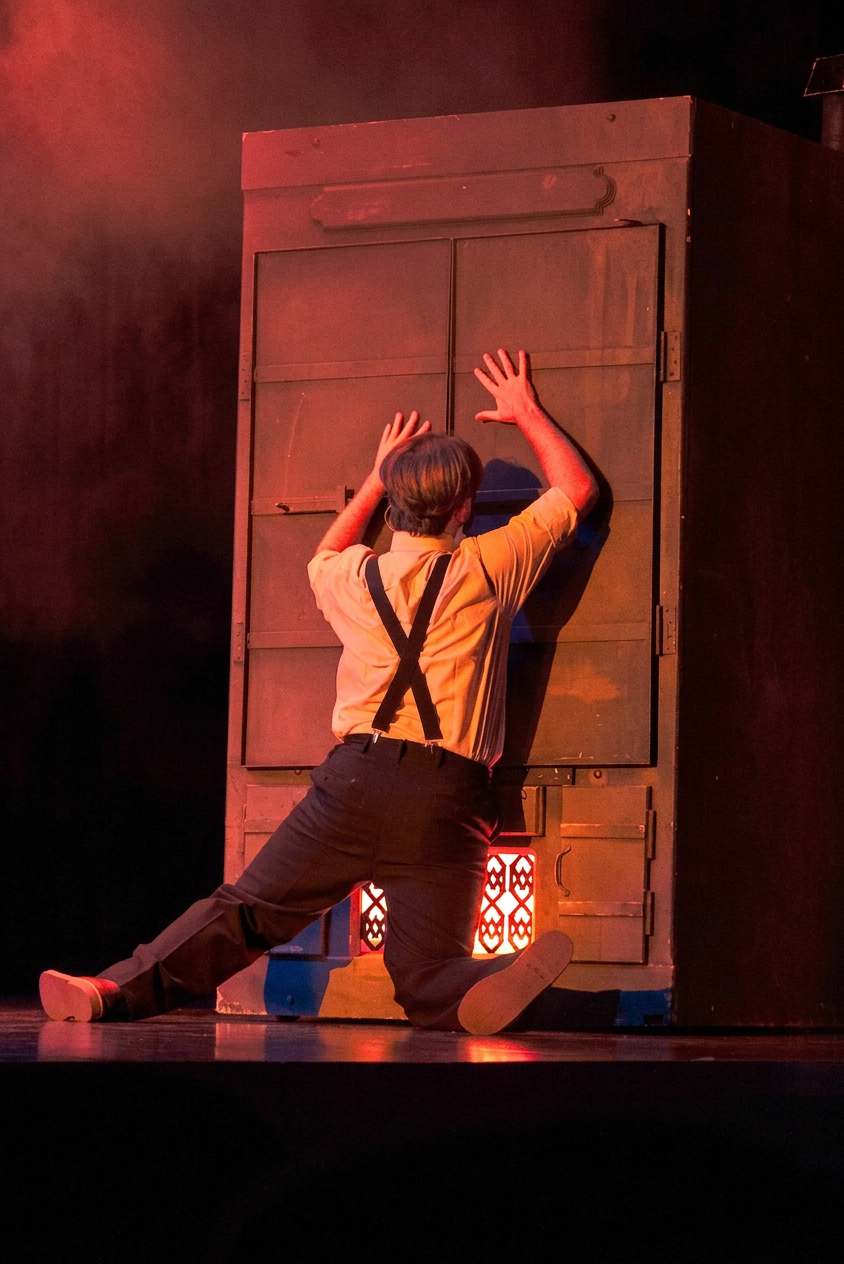
The video below is from preview night. Despite its angle and slight shakiness (I got better at recording scenes as performances continued) it is included in this article to showcase the acting choices made by the actor playing Todd, Benjamin Nault, while his hands were burning in order to keep the oven doors shut. His screams of agony brought realism and absolute shock to the moment.
The other way I built upon this sequence for Todd was the moment after Lovett is killed. In most productions, including Prince’s original staging, Todd quickly dashes back to the Beggar Woman’s body immediately following Lovett’s death. While this can be justified by saying that Todd only killed Lovett so he could get back to the Beggar Woman, it always came across to me as not letting Lovett’s horrific death sit with the audience. Because of this, I decided to take a different route. After Todd burns his hands and recovers from the moment, he would take his time painfully crawling over to the Beggar Woman. I wanted to let this plot heavy fast-paced show come to a grinding halt. Later in performances, I found that taking time after Lovett’s death in turn helped set up for the pacing and mood of Todd’s undoing by Tobias.
A Quick Note on Lighting
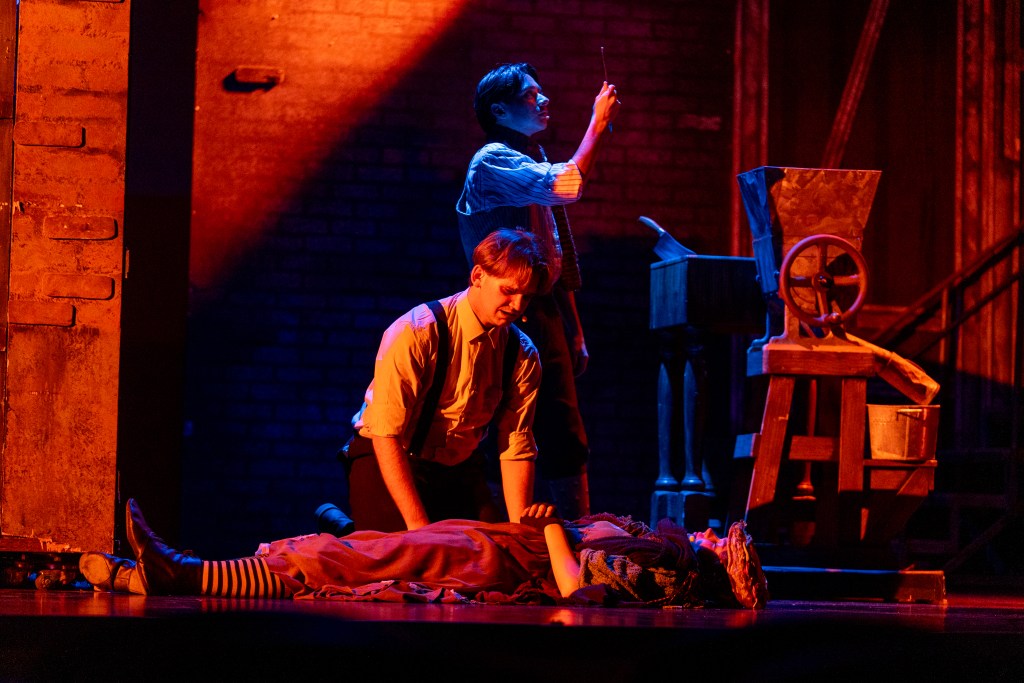
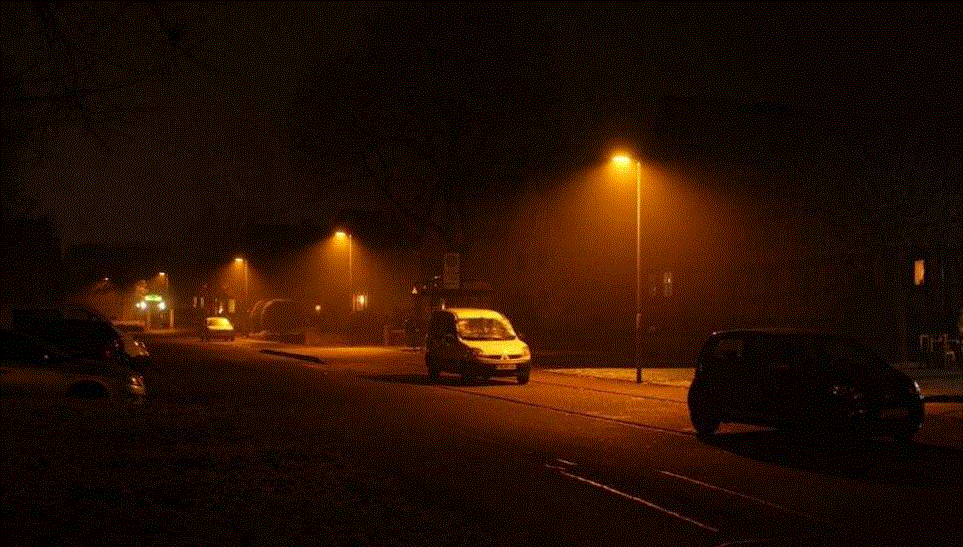
Not only did I co-direct, music direct and co-costume design this production of Sweeney Todd, but I was also the lighting designer. To light scenes that took place in the bakehouse, I decided to use very little light, compared to other scenes I lit in the show, in order to create a sense that no outside light came into the bakehouse (like a downstairs basement) and I primarily used side lighting to help create shadows as actors moved throughout the space. The primary color I used for the bakehouse was orange for a multitude of reasons. The first being was to make the bakehouse look like Hell, as this room was the place where innocent bodies were disposed of, chopped into pieces and placed into a meat grinder. The second reason was to give a sense that the only light source coming from this room was from the oven itself, an idea I took from the 2007 film. The third reason was an homage to the amber streetlights outside my grandparents house in upstate New York. When I would sleepover there as a child, the windows of the guest bedroom showed amber lights on quiet empty roads which absolutely terrified me as a child. It only felt natural to bring these unfriendly amber lights to the horrific bakehouse. I used the color blue to counter balance the orange and was used as the “darkness” in the room.
A Quick Note on Music Direction
In observing different productions over the years, there was one approach to Lovett’s reprise of “Poor Thing”, the moment where Lovett honestly tells what happened to Lucy and boldly announces her love for Todd, that has bothered me. I have found that most Lovetts during the patter section (“No no not lied at all, no I never lied”) over-emote or are on the verge of tears and I find this approach incorrect. Lovett is “eminently practical”, quick-witted and of course would have a back up plan of what to say for the worst case scenario if Todd found out, there would be no need for her to be nervous or emotional at that point. While Lovett is telling her side of the story, Todd is blatantly ignoring her, only staring at Lucy. Lovett believes this lie was for the best and with Todd once again ignoring her due to her rival, Lucy, Lovett feels that all her hard work to gain Todd’s affection was all for not. Therefore, it is not until “Yes I lied cause I loved you, I’d be twice the wife she was” Lovett can and should be emotional, but not any sooner than that. When teaching the music for this scene, I instructed my actress playing Lovett to be coldly strict in tempo and not to emote till, “I love you”.
Furthermore, it was during this music rehearsal I brought up to my actors playing Todd and Lovett a lyrical observation. At the end of this musical segment, Lovett sings “Could that thing have cared for you like me?”. Sondheim specifically chose Lovett to call Lucy “that thing” rather than saying “she” or “Lucy”. To me, I believe calling Lucy “that thing” was the final straw to break the camel’s back for Todd, ramping up his need to immediately destroy her.
In Practice
To begin with, safety was my number one concern, not only for Lovett’s death but for other crucial parts in the show. I have heard so many horror stories of actors being hurt in Sweeney Todd (particularly Beggar Womans and their descent down the chute) so I ensured that safety was our top priority by doing daily fight calls and check-ins with my actors with the physical and emotional demands Sweeney Todd requires. For the day I staged Lovett’s death, I ensured the actress playing Lovett was just as much in control as Sweeney and made sure that the actor playing Sweeney would not hurt his hands by bringing down a heavy metal bar to close the oven doors. Furthermore, to ensure our Lovett didn’t have her legs being hit by the doors quickly closing in on her, I taught my actress to pick up her legs in the style of a back somersault. Later when our fog machine (located at the bottom of the oven) was installed, I instructed my actress to close her mouth and cup her hands around her month so none of the fumes would get into her mouth.
While in rehearsals and all the way up to our preview night, I kept on tweaking this particular scene. One adjustment came from an idea that Lovett would get down to Todd’s level as she professed his love to him. Todd would get up as Lovett recoiled and backed up. Todd looks down at her menacingly, only then to lend her a hand, help her up off the floor and lead her to dance. While this concept was briefly explored in the 2023 revival by Sutton Foster and Aaron Tveit, I gave up on this idea due to where the actress playing Lovett was placed in relation to the oven. When she flinched and recoiled back as Todd looked down on her, it gave away what was going to happen to her in advance. I went back to Hal Prince’s original staging with Todd walking away from the lifeless body of the Beggar Woman and the oven to ask Lovett for a dance with Lovett willingly following him.
Another choice I experimented with was having Todd fling his arms up and away to look like it was a big push. Unfortunately, it did not come across as effectively as I hoped it would, killing the momentum I was working towards. I went back to having Todd quickly flinging Lovett in and briskly closing the doors.
The final adjustment came on preview night when I came to a decision on what word Todd would grab Lovett on. When Todd sings “And life is for the alive my dear, so let’s keep living it”, I originally I had the actor playing Todd grab her on the word “alive” and then proceed to walk towards the oven. Although I thought it would be important and ironic for Todd grab Lovett on the word “alive”, the timing for that word with the walk to the oven and the toss of Lovett were not lining up the way I wanted to with the music. Therefore on opening night, I changed it to Todd grabbing Lovett on the words “so let’s”. This fortunately worked in our favor, helping with the timing of the push and the element of surprise.
This video from a Friday night I found to be one of the best examples of the scene.
When performances began, my actor playing Todd experimented and changed how holding onto the oven doors burnt him at each performance , which I greatly liked and approved of. On closing night, my actress playing Lovett did something different from prior performances. As she sang, “By the sea Mr. Todd we’ll be comfy and cozy/You and me Mr. Todd where there’s no one nosy”, the actress slowed down and began to look frightened as if she knew something was off. As Todd grabbed her and walked her back, she began to hysterically cry while screaming “Let go of me! Let go!”, giving into the tragedy of the moment. The actress didn’t even look back as if to signify Lovett knew where she was heading towards.
(By closing night, I was able to figure out how to stable the camera and have a crystal clear image)
Conclusion
Not only was it a personal fulfillment to direct this musical that has meant so much to me in my lifetime but also to finally give Lovett’s death the proper care and staging this horrific moment deserves. I would like to thank my co-director Travis Blumer in addition to my actors Izzy LaFalce and Benjamin Nault who helped bring my vision of this marvelously macabre moment to life.
P.S. On closing night before the show began, I too got to experience what this moment was like. And let me tell you, to not have my actress scream in the fog was an excellent idea…
Photo Credit
Jameson Grohman, Izzy LaFalce
Copyright Notice
COPYRIGHT ACT OF 1976: CODE 107
Notwithstanding the provisions of sections 106 and 106A, the fair use of a copyrighted work, including such use by reproduction in copies or phonorecords or by any other means specified by that section, for purposes such as criticism, comment, news reporting, teaching (including multiple copies for classroom use), scholarship, or research, is not an infringement of copyright. In determining whether the use made of a work in any particular case is a fair use the factors to be considered shall include the purpose and character of the use, including whether such use is of a commercial nature or is for nonprofit educational purposes.

